
Ozempic Face Treatment: How Botox and Hyaluronic Acid Fillers Restore What GLP-1 Weight Loss Takes Away
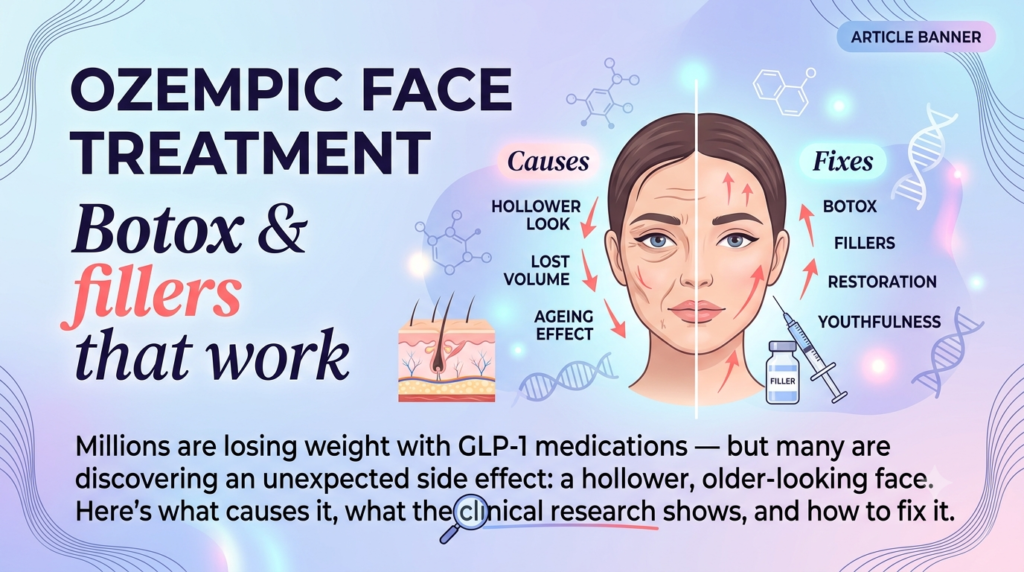
Lost facial volume on Ozempic or Mounjaro? Learn how Botox, hyaluronic acid fillers, and biostimulators restore what GLP-1 weight loss takes from your face — backed by clinical research. Ozempic Face Treatment: Botox & Fillers That Work GLP-1 & aesthetic medicine Ozempic face treatment: Botox & fillers that work Millions are losing weight with GLP-1 medications — but many are discovering an unexpected side effect: a hollower, older-looking face. Here’s what causes it, what the clinical research shows, and how to fix it. Clinical references included · Updated June 2026 What is Ozempic face — and why does it happen? You stepped on the scale and saw the number you worked toward. Then you looked in the mirror and saw something you didn’t expect — a face that looked sunken, tired, and older than before you started losing weight. You’re not imagining it. Dermatologists now have a name for it: Ozempic face — the constellation of facial changes that accompany rapid weight loss from GLP-1 medications like semaglutide (Ozempic, Wegovy) or tirzepatide (Mounjaro), bariatric surgery, or aggressive dieting. The face isn’t a uniform fat layer. It’s a complex architecture of distinct fat compartments, ligaments, muscles, and skin. When weight is lost rapidly, those compartments deflate — but the overlying skin doesn’t retract at the same pace. A systematic review published in the Aesthetic Surgery Journal Open Forum documented significant reductions in facial fat compartments including the temporal and cheek fat pads, with patients appearing meaningfully older following massive weight loss. (Jafar et al., 2024) A separate study found that blinded evaluators consistently rated post-weight-loss photographs as older and less attractive compared to pre-weight-loss images of the same patients. (Hess et al., 2015) GLP-1 medications may also directly affect the skin beyond fat loss — a comprehensive review confirmed these drugs can contribute to dermal thinning, decreased skin elasticity, and accelerated skin aging independent of weight change. (Eaton et al., Diseases, 2025) Type 1 Volume-driven aging Hollowness, sunken temples, deflated cheeks, and deepened folds caused by fat pad deflation — visible at rest, independent of muscle movement. Type 2 Movement-driven aging Dynamic wrinkles that look deeper on skin that no longer has the fat cushion beneath to soften repeated muscle contractions. Two types of facial aging, two targeted treatments Botox for dynamic wrinkles after weight loss Forehead lines, frown lines, and crow’s feet are caused by muscles repeatedly contracting beneath the skin. After weight loss, those lines look deeper — because the fat that once cushioned them from below is gone. Botulinum toxin (Botox, Dysport, Xeomin) temporarily relaxes the target muscles, stopping the mechanical force that engraves lines deeper over time. It doesn’t restore volume — but it prevents ongoing muscle activity from worsening the damage while other treatments address structural loss. A Global Aesthetics Consensus review confirmed an evidence-based shift toward combination neuromodulator and filler treatment to address both dynamic and structural facial concerns simultaneously. (Liew et al., PRS, 2016) Hyaluronic acid fillers for facial volume loss Hollow temples, sunken under-eyes, flat cheeks, deepened nasolabial folds — these are structural deficits, not muscle problems. They exist because the fat scaffolding beneath the skin has been lost. Hyaluronic acid (HA) fillers — Restylane, Belotero, Teosyal, Hyabell — physically replace that lost structural volume in multiple viscosities: thicker, more cohesive gels for deep cheek and temple volumisation; softer, more pliable formulations for delicate areas like the tear trough. A whole-face HA filler approach has been shown to address age-related volume changes across all facial zones when products are matched to the anatomical needs of each region. (Lipko-Godlewska et al., CCID, 2021) Why Botox and fillers work better together Combining both produces results neither achieves alone. Botox reduces the muscle tension that would otherwise degrade filler placement over time, while fillers restore the structural foundation that makes Botox results look natural rather than flat. A Global Aesthetics Consensus concluded that combination treatment is now the standard of care — shifting from single-modality rejuvenation toward comprehensive facial harmonisation. (De Boulle et al., PRS, 2016) How to sequence the treatments Option A — same day Fillers first, Botox second Fillers are placed into deep tissue planes first. Botox is administered last, protecting filler precision — Botox injected first causes swelling that can distort placement. A published single-visit pan-facial approach confirmed the safety and practicality of this sequence. (Chao, PRS Global Open, 2018) Option B — split sessions Botox first, fillers two weeks later Botox is done first. After two weeks — once muscles have fully relaxed — fillers are placed into a stable, low-tension environment, reducing migration risk in high-movement areas. (Hall, Plastic Surgical Nursing, 2024) Zone by zone: where Ozempic face shows up Individualized treatment planning across anatomical zones — based on each patient’s specific pattern of volume loss and muscular activity — is essential for natural-looking results. (Farolch-Prats & Nome-Chamorro, Aesthetic Plastic Surgery, 2019) Temples One of the first areas to hollow, creating a skeletal appearance. HA filler rebuilds lateral facial fullness and restores a naturally rounded upper face. Midface & cheeks The structural core most dramatically affected by fat pad loss. Deep-plane filler lifts the entire midface framework, indirectly softening nasolabial folds. Tear trough Periorbital hollowing creates persistent dark shadows. HA filler along the orbital rim reshapes the 3D periorbital complex and reduces hollow eyes. Lower face Botox softens a downturned mouth and chin dimpling. Marionette lines, accordion lines, and nasolabial folds are refined with filler. Why GLP-1 patients need a different approach Patients on GLP-1 medications aren’t standard cosmetic patients. Simple spot-filling under-delivers because their facial aging is multi-layered — involving fat loss, skin quality changes, and potentially direct drug-related dermal effects all at once. A case series demonstrated that patients treated with a staged injectable protocol showed dramatic improvements in quality of life and psychological function. (Lee & Rullan, Cureus, 2023) The recommended approach is layered and staged over 6–12 months: 1 Biostimulators — rebuild the collagen scaffold Before adding volume, the dermal scaffold needs rebuilding. Sculptra (PLLA), Radiesse
